Showing posts with label abstract art. Show all posts

Tuesday, 25 February 2014

Abstract Holiday

from time to time my paintings start to become "samey" and I begin to lose my way, creatively speaking. Things stop working for me and I lose interest. It is on these occasions that I allow myself an "abstract holiday".

I can paint what I like, no need to worry about producing a great masterpiece and  it really helps me to find my way again.


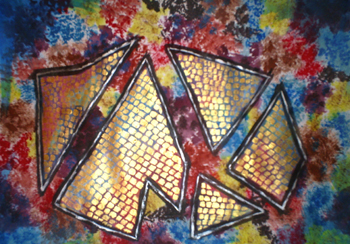
This is tonight's result. I did not start with any preconceptions except that I was going to make this a work in two halves, with a large red area on one side, the smaller side of the paper. It is in pastel and is painted on a very rough 200 lb water colour paper; size about 16 x 12 inch.

Of course everyone thought it was an image of buildings but I did not have this in mind at all when in the process of  painting. It was purely geometrical considerations which were uppermost in my mind.

Of course, the magic of digital editing means that once I have the image in digital form, I can play around with the colours to my hearts content. In fact the original has been "re-coloured" so that the larger blue area has been made bluer to hide the purple/violet which I found I did not like. I normally do a series of thumbnail sketches to see if a colour combination works before I start on the actual painting. Unfortunately I did not do this with this painting.

Just to show the effect of different colours and degree of saturation, I include two edited images.


All three are better than the ooriginal unfortunately, c'est la vie!

Saturday, 23 February 2013

How To Learn To Paint Abstracts - Free eBook

First of all, painting abstracts is about painting the feelings that are bought about by a subject, rather than painting the subject. You are not trying to represent the physical appearance of the subject. Therefore, you cannot get it wrong. Only you know how you feel about something, the painting is your way of describing these feelings to your audience.

Many artists however feel awkward about this. They have grown up believing that a painting is "of" something and should look like the original. This must be overcome to paint expressive abstract paintings.
 I would be the first to say that I still have problems with putting thoughts into abstract paintings but I will most stronly claim that by painting abstracts I have improved as a painter immensely. I have a very loose almost semi-abstract style and enjoy painting with colour. You can see what I mean by browsing a few of the earlier posts on this blog. I do find that fellow artists do find some, if not all, of my work pleasing and likeable. Not sure what this means but looseness is something that many artists seek. It works for me, and I find this style so much easier since beginning abstract painting.

When I was asked by my art group to run a workshop on abstract painting, I developed a methodology to enable them to try it out for themselves. I have written about this on Squidoo and you can read and see a step-by-step tutorial here:-


and


I have also collated these articles together into one, free eBook available on Scribd for download.

I will in the near future be completing a "game" utilising sets of cards to give the arrtist some basic starting points to help with creating abstracts . I shall be saying more of this later.

Monday, 4 June 2012

Painting Abstracts - how to learn by doing

I have always been interested in abstracts, weel since I sold my first abstract painting. What is it about an abstract which interests people? I do not believe I know but they do sell. Have you considered this genre, many realistic painters find it difficult to create abstracts because they cannot let themselves go. Creating a painting based on composition rather than on a subject is difficult for many people, I had to lead a workshop on painting an abstract at my art group and came up with this methodology to allow and enable such a person ( a realistic painter) to start and complete a painting in an evening.


An example created by this method
acrylic on paper, approximate size A4 (11x8.5 inches)
  1. Get the surface covered. A background is easier said than done for some, but simply dont think about it. Just pick a colour! Put down a wash, add texture or patterns. Or draw and paint a grid. It doesn't have to be rectangular or even geometric. Think circles, distortion. But don't think too hard, just cover that surface covered. This is PRACTICE not a masterpiece.
  2. Now, throw in some shapes, lines, colours; just add a little interest. Think in compositional terms. Contrast / Unity / Size / direction / texture / etc. Again this is to allow you to paint an abstract no need to think about what it means or represents. Throw or drip, use a stick or your hand, but do something.
  3. Lastly look carefully and see what is needed to add a little pizazz. I know its not a masterpiece but not all paintings are! Just have fun, fun and more fun. You know about composition, the elements and the principles. If not now is the time to learn. Use this knowledge to make your painting interesting, and don't forget, it does not have to mean anything.
  4. You are finished! stand back and take a bow
  5. Now do another
  6. Using this method you can paint several at once, one of them will probably be good enough to frame.
OK, so you don't believe me and want more information. I have started to write a series of Squidoo lenses (= webpages) on this methodology. Try these for examples and more information.

More will be added in the near future. Just remember, this is not a recipe for a masterpiece but will give you permission to do something which is different and which will ultimately help to loosen your artwork in all genres.


A recent sale at my art groups March exhibition, Title: Yellow Landscape
A pastel painting, approximate size A4 (11x8.8 inches)